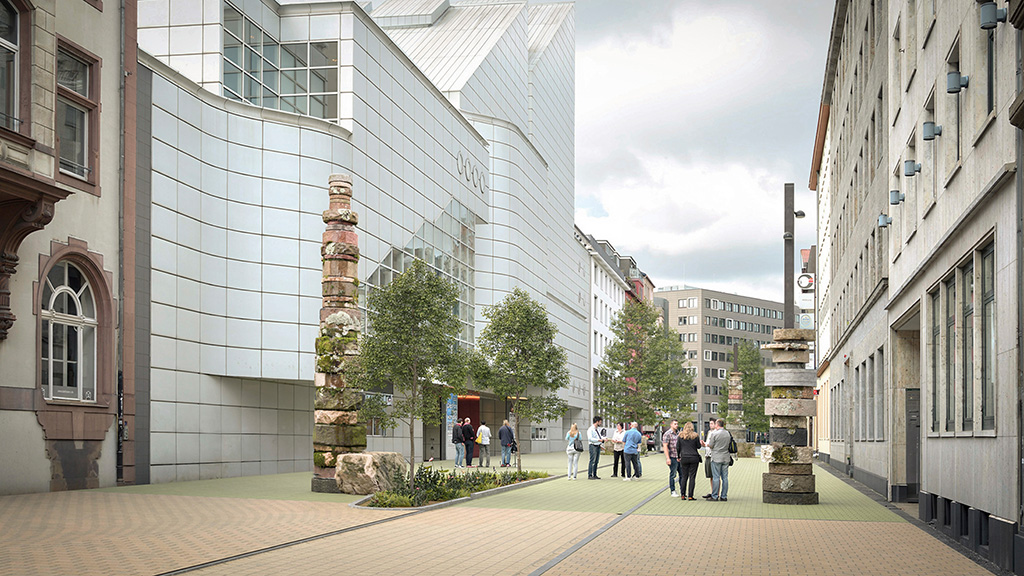
A work of art and design proposal for Prinzenstraße in Hanover by the artist Ingo Vetter and the architect Michelle Howard, in collaboration with Manuel Gruber and Ruth Lübke.
Millstones are a cultural heritage – precursors to the Industrial Revolution, witnesses to the first wave of mechanisation, the centralisation of production processes and the emergence of entrepreneurship. The mills have disappeared, the machinery has rusted away, and the working relationships have dissolved. The grinding cores of these facilities were preserved as if they were family heirlooms. The post-war generation rolled the millstones into allotments or used them to decorate detached houses. They once defined an identity, but no longer do so today. So the current generation is rolling them out again. Classified adverts and markets for historic building components are full of these Alte Sachen. This shows that whilst they may have lost some of their significance, their value is still recognised.
Historically, Hanover and its surrounding area were an important milling region, which laid the foundations for later industrialisation. This rich heritage is now becoming a central design element: like stacks of coins from a currency no longer in use, the millstones sit atop the remaining – though now defunct – tram poles on Prinzenstraße. Three stacks are proposed in the central zone in front of the theatre, two of which are equipped with a water supply. The calcareous tap water from Hanover flows over the stacks of millstones and evaporates, thereby helping to improve the climate. At the same time, genuine calcareous tuff grows on the wet stones over time – porous, living, a rock that multiplies of its own accord. Algae, lichens and mosses creep over the stacks, followed by taller plants. Something new emerges from the old, and the stones grow. At the foot of the millstone stacks, large blocks of volcanic tuff are installed – a rock that can absorb up to 25 per cent by volume of water, just like a sponge. It absorbs the residual water, stores it and slowly releases it again.
The stacks of millstones and the striking tuff blocks lend themselves as design elements for the entire Prinzenstraße, and an extension of the competition entry could create seating areas and emphasise the street entrances at Thielenplatz and Schiffsgraben.
The real challenge lies in collecting these Alte Sachen: whilst searching for and collecting the millstones, their origins and histories are documented. The result will be a publication making all the millstone stories available for further processing and interpretation. The artistic task is to tell a new story for Hanover.
With the theatre behind it – a place filled daily with grand emotions and even grander words – it is gaining silent neighbours. The millstones are piling up against the old tram poles – basalt, limestone and sandstone, granite, colourful and heavy. These are Alte Sachen that, in the public eye, are once again telling their stories, being watered and beginning to grow.
Further information is available on the website of the state capital, Hanover.
Press conference and presentation of the public art commission on Tuesday, 21 July 2026 at 12:30 pm.
Address: Künstlerhaus Hannover, Sophienstraße 2, 30159 Hannover, Germany
Recent Comments